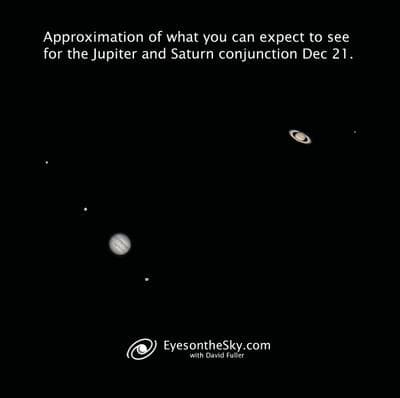
Triple conjunctions don't happen all that often in the night sky, but when they do, they are a sight worth seeking out. This week, as the Earth hurtles around the Sun more quickly than Jupiter, the giant planet will sink rapidly towards the horizon. But as it does, two other planets, Mercury and Venus - both orbiting faster than Earth - rise up to meet it by the weekend. All three can be seen naked eye, though binoculars will make it easier to find and see Mercury early in the week, especially as twilight fades and Venus becomes visible before the innermost planet does. Friday, Saturday and Sunday offer the best, and closest views of the three planets together, but this trio is worth observing all of this week and into next week.
Eyes on the Sky astronomy videos are now closed captioned, allowing for translation into 58 languages as well as benefitting the hearing impaired. Or, watch at work! Just don't tell your boss.
Beginning astronomy? Eyes on the Sky makes astronomy easy, with lots of FREE resources right here!
And because unexpected events occur (like supernova, comets and other phenomena), special astronomy events videos are occasionally offered. Plus there's a full astronomy glossary and downloadable Greek alphabet PDF. For the do-it-yourself folks, see the DIY-astronomy section - save money on astro equipment, or build it for the satisfaction of having done so.
I talk about dark sky friendly lighting fixtures a lot - I mention them in most every video, in fact. But what are they? You can find various types of dark sky friendly lighting fixtures here, or try these lighting manufacturers - and if you still have trouble locating them, contact me. NEW AS OF JANUARY 2013: The U.S.-based home improvement store Lowes that has stores in Canada and Mexico now carries dark sky friendly lighting with the IDA seal of approval - look for them in your store. If I can't track them down, I'll get you in touch with people who can help you.
Got a neighbor with a light shining in your bedroom or window somewhere in your home? Here's how to approach a neighbor about poorly shielded lighting. You can also find the silver-crown light bulbs highlighted in previous "Dark Sky Facts" from these online retailers: 1000Bulbs.com Light Bulb Emporium
Making "Eyes on the Sky" every week isn't free. Not only do I spend 10 to 12 hours on each 5-6 minute video by the time I research, write, shoot, create graphics, edit and upload each video, but some graphics, music, costumes and other things I add all cost money. So I'd ask one of two things from you: Please either change your own outdoor lights and encourage your neighbors to do the same, or donate a bit towards my efforts to spread the word through these videos. Even as little as $5 helps - yes, really - but what would help more is a monthly subscription of $3 a month. That's only $0.69 an episode! And you don't even need a Paypal account; you can donate or subscribe with any major credit card you see in the button graphic. Thank you - I appreciate your support!
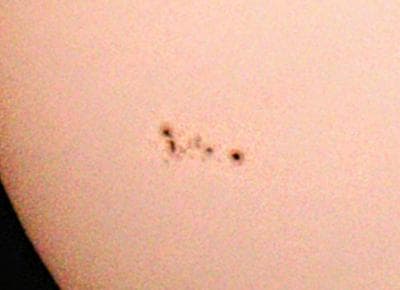
Viewing our closest star, the Sun, can be fun - and potentially dangerous if done wrong or with unsafe methods. For more information about solar viewing and safety, please click here.
Stargazing / "what's in the night sky this week" videos for the past several weeks may be found in the Videos section.
Beginners to stargazing have lot so questions about telescopes, like what types are out there? How do I calculate magnification? What eyepieces should I get? What is barlow lens? Get your questions answered here, quickly and easily, at the Informational Videos page.
Special event astronomy videos about the supernova in M101 or the peak brighness of Mira, are available in the Special Events page.
Last year's "Eyes on the Sky" videos may be found in the 2011 Videos area.
Free stuff is good, right? How about free star charts so you can find things in the free videos discussed in "Eyes on the Sky" videos? Click on the Star Charts linkfor PDF star charts you can download and use to see 'what's up!'
Not enough you say? No problem! Learn the stars that you can see each season of the year - even from light polluted areas - with these guides that take you through the constellations step by step in winter, spring, summer and autumn.
What else you ask? How about free videos that help you with stargazing, like how to align an equatorial mount to the celestial pole, or why planispheres are a useful tool in astronomy. You can find those resources in the Informational Videos section.